

Football streaming has become the preferred way for millions of supporters to watch matches online. Whether fans are following domestic leagues, international tournaments, or checking coverage through platforms such as HesGoal Football or HesGoal Football Live, one factor significantly affects the viewing experience: video quality.
Have you ever started watching a match and noticed the picture looked blurry? Or perhaps you’ve switched to another stream and suddenly every pass, tackle, and goal appeared crystal clear. The difference often comes down to HD and SD streaming.
Many football fans understand that HD looks better than SD, but fewer know why the difference exists or how factors like resolution and bandwidth influence stream performance. Understanding these basics can help viewers make better decisions and enjoy a smoother football streaming experience.
Why Streaming Quality Matters
Football is a fast-paced sport.
Players constantly move across the pitch, the ball travels at high speed, and tactical movements happen in seconds. When streaming quality is poor, important details can become difficult to see.
Good video quality helps viewers:
- Follow the movement of players
- See tactical formations clearly
- Enjoy stadium atmosphere
- Read scoreboards and match statistics
- Experience the game more naturally
The better the quality, the more immersive the viewing experience becomes.
What Is SD Streaming?
SD stands for Standard Definition.
For many years, SD was the primary format used for television broadcasts and online video content. Although technology has improved significantly, SD streams are still available on various platforms today.
Common SD resolutions include:
- 480p
- 576p
These formats require less internet data and are easier to stream on slower connections.
Benefits of SD Streaming
SD remains useful in certain situations.
Advantages include:
- Lower data consumption
- Reduced bandwidth requirements
- Faster loading times
- Better performance on slow internet connections
Users with limited internet speeds may find SD streaming more reliable during busy match periods.
Drawbacks of SD Streaming
The main disadvantage is visual clarity.
Viewers may notice:
- Less sharp images
- Blurred player details
- Reduced stadium visibility
- Lower overall viewing quality
While SD remains functional, it often struggles to meet modern viewing expectations.
What Is HD Streaming?
HD stands for High Definition.
This format provides significantly improved visual quality compared to Standard Definition.
Popular HD resolutions include:
- 720p
- 1080p
Many football supporters consider HD the ideal balance between performance and picture quality.
Benefits of HD Streaming
HD offers several advantages.
These include:
- Sharper images
- Better player visibility
- Improved color accuracy
- More immersive viewing experience
- Enhanced stadium atmosphere
For football streaming, HD allows supporters to appreciate details that might be difficult to notice in lower-quality formats.
Drawbacks of HD Streaming
Despite its advantages, HD has certain requirements.
Challenges include:
- Higher bandwidth usage
- Increased data consumption
- Greater internet stability requirements
Users with slower connections may occasionally experience buffering when viewing HD content.
Understanding Resolution
Resolution is one of the most important factors affecting video quality.
It refers to the number of pixels displayed on a screen.
More pixels generally result in a clearer image.
Common Streaming Resolutions
480p
Often associated with SD quality.
720p
Considered entry-level HD.
1080p
Full HD and one of the most popular streaming formats.
1440p
Higher-quality viewing with improved detail.
4K
Ultra-high-definition content providing exceptional clarity.
When discussing football streaming, resolution directly influences how sharp and detailed the match appears.
Why Resolution Matters in Football
Not every type of content requires high resolution.
Football is different because action constantly moves across the field.
Higher resolution allows viewers to:
- Track player movement more easily
- Follow the ball during long passes
- Observe tactical positioning
- Enjoy clearer replays
For supporters watching full matches, improved resolution can significantly enhance enjoyment.
Understanding Bandwidth
Bandwidth plays a crucial role in streaming performance.
In simple terms, bandwidth refers to the amount of data that can be transferred through your internet connection over a specific period.
Higher-quality streams require more bandwidth.
If sufficient bandwidth is unavailable, viewers may experience:
- Buffering
- Reduced quality
- Playback interruptions
- Loading delays
Many streaming problems are actually bandwidth issues rather than platform issues.
Recommended Bandwidth for Different Qualities
While requirements vary between services, general recommendations include:
SD Streaming
3 to 5 Mbps
HD Streaming
5 to 10 Mbps
Full HD Streaming
10 to 15 Mbps
4K Streaming
25 Mbps or higher
Maintaining adequate bandwidth helps ensure a smoother viewing experience.
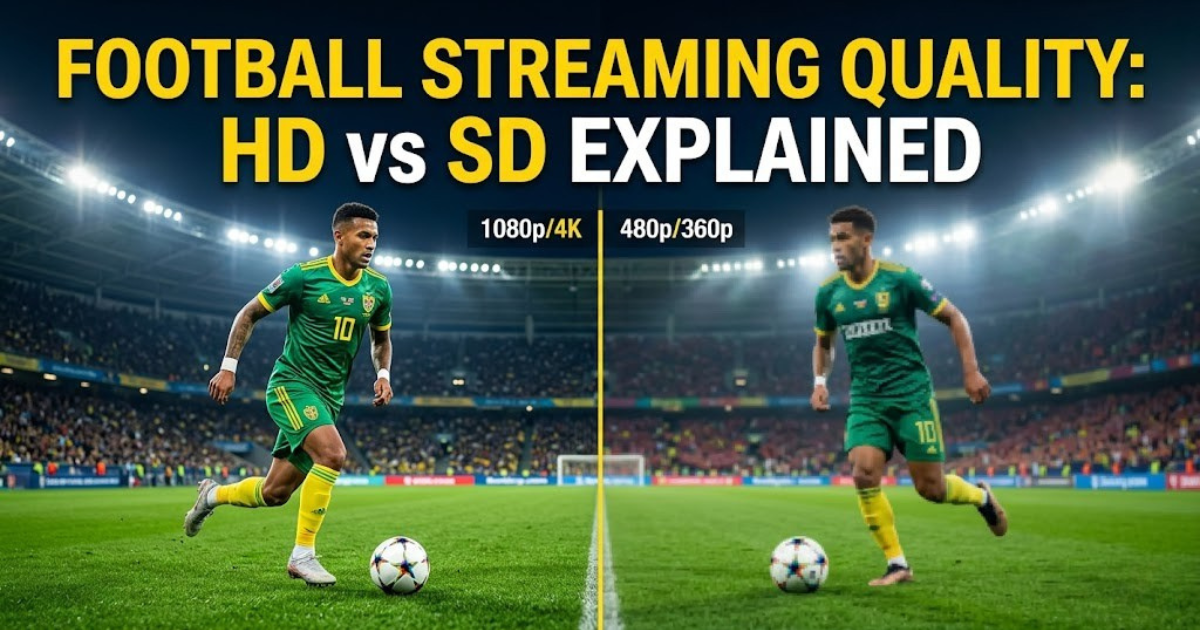
HD vs SD: Real Football Viewing Comparison
Imagine watching a major football match.
In SD quality:
- Player numbers may appear less clear
- Crowd details become harder to distinguish
- Long passes may be less visually sharp
- Stadium visuals appear softer
In HD quality:
- Player movements become clearer
- Match graphics are easier to read
- Ball movement is easier to follow
- Overall presentation feels more professional
This comparison explains why many supporters prefer HD whenever possible.
Device Size Makes a Difference
The importance of video quality often depends on screen size.
Smartphone Viewing
On smaller screens, SD may still look acceptable.
Tablet Viewing
The difference between SD and HD becomes more noticeable.
Laptop Viewing
HD generally provides a superior experience.
Television Viewing
Large screens highlight quality differences dramatically.
For smart TVs and larger displays, HD is usually the preferred choice.
Why Some Streams Automatically Change Quality
Many viewers notice that streaming quality sometimes changes during a match.
This occurs because modern platforms use adaptive streaming technology.
The system automatically adjusts quality based on:
- Internet speed
- Network stability
- Device performance
- Available bandwidth
This helps reduce buffering while maintaining continuous playback.
How HesGoal Football and HesGoal Football Live Fit Into Modern Viewing
Football supporters often search online for match information, schedules, and football-related content through platforms such as HesGoal Football and HesGoal Football Live.
As football streaming continues to grow, users increasingly pay attention to viewing quality and stream stability. Whether watching league matches, cup competitions, or international tournaments, fans consistently seek reliable access and better picture quality.
The growing focus on HD viewing reflects changing expectations among modern football audiences.
Common Causes of Poor Streaming Quality
Even users with fast internet occasionally encounter problems.
Several factors can reduce streaming performance.
Network Congestion
Heavy internet usage during major matches can affect quality.
Weak Wi-Fi Signals
Distance from the router may reduce connection stability.
Older Devices
Outdated hardware sometimes struggles with higher-quality streams.
Background Applications
Other programs may consume bandwidth without users realizing it.
Identifying these issues can improve overall viewing quality.
Tips to Improve Football Streaming Quality
If you’re experiencing problems, several simple steps may help.
Use a Stable Internet Connection
A reliable connection remains the most important factor.
Close Unnecessary Applications
This frees system resources and bandwidth.
Restart Your Router
Many connection issues can be resolved through a simple restart.
Update Your Device
Updated software often improves compatibility and performance.
Choose Appropriate Quality Settings
If buffering occurs frequently, lowering resolution may provide a smoother experience.
Is HD Always the Best Choice?
Not necessarily.
While HD offers better video quality, the best option depends on individual circumstances.
SD may be preferable when:
- Internet speeds are limited
- Mobile data usage is a concern
- Network congestion is high
HD is generally preferable when:
- Stable broadband is available
- Larger screens are used
- Viewing quality is a priority
The goal is finding the right balance between visual quality and streaming stability.
The Future of Football Streaming Quality
Technology continues advancing rapidly.
Future developments may include:
- More widespread 4K streaming
- Improved compression technologies
- Faster internet infrastructure
- Enhanced mobile viewing experiences
- AI-powered quality optimization
These innovations could further improve football streaming for supporters worldwide.
Conclusion
Football streaming quality has a major impact on how fans experience matches online. While SD remains useful for slower internet connections, HD delivers significantly better video quality, sharper resolution, and a more immersive viewing experience.
Understanding the relationship between resolution, bandwidth, and stream performance helps supporters make informed decisions when choosing quality settings. Whether following domestic leagues, international competitions, or checking football-related content through HesGoal Football and HesGoal Football Live, viewers can improve their experience by selecting the quality level that best matches their connection and device.
For most modern football fans, HD has become the preferred standard. However, the best viewing experience always comes from balancing picture quality with stable performance, ensuring every goal, save, and memorable moment can be enjoyed without interruption.