

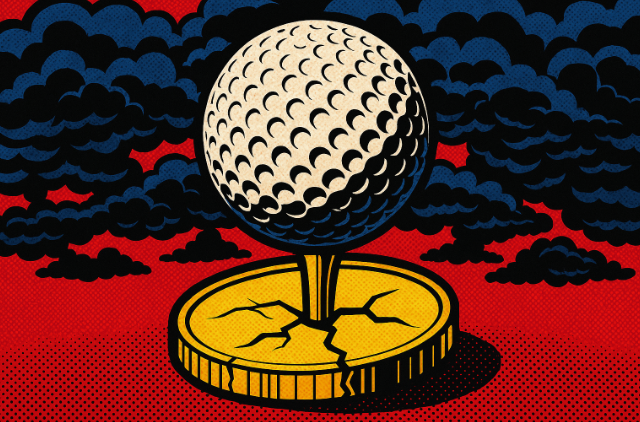
For three years, LIV Golf answered nearly every question with the same resource: money. Backed by Saudi Arabia’s Public Investment Fund (PIF), the breakaway circuit signed marquee players, staged team events on four continents and pushed prize funds to levels the established tours could not match. Now the question that once seemed settled has returned with force. How long can a golf league lose money at this scale, and what happens when its sole backer signals the tap is closing?
How LIV Was Built, and What It Cost
LIV Golf launched in 2022 as a PIF-funded venture, offering guaranteed contracts, no cuts and a team format aimed at a younger audience. The recruitment was aggressive from the start. Reporting on LIV’s finances has since put the fund’s total commitment above $5.3 billion, approaching a reported $6 billion once the 2026 season is accounted for. Roughly a billion of that is said to have gone on signing players such as Bryson DeChambeau, Phil Mickelson, Brooks Koepka and Dustin Johnson. Prize money climbed year on year, reaching a reported $32.3 million per event in 2026, with average monthly spending across 2024 and 2025 estimated at around $100 million.
Those figures explain both LIV’s rapid rise and the doubts that trail it. According to filings and reporting cited across the golf press, the league’s cumulative losses since inception have reportedly passed $1.1 billion, with net losses in 2024 alone reported at $461.8 million. LIV’s own leadership has been candid about the timeline: chief executive Scott O’Neil has said the league may not turn a profit for another five to ten years. For an ordinary commercial venture those numbers would be alarming. For a sovereign wealth fund with assets measured in the hundreds of billions, they were, for a time, absorbable.
Why Questions About Sustainability Keep Surfacing
The sustainability question has never really gone away, and a recent insider account gave it fresh weight. Broadcaster Trey Wingo relayed claims from an unnamed source suggesting the PIF’s sports division had been unable to deploy fresh capital for months, details about the reported funding strain that few outside the fund had anticipated. The same account tied delayed player payments to that freeze, pointing to reports that some competitors were reluctant to tee off in Mexico City before first-quarter money arrived. None of it was confirmed by PIF or LIV directly, and it should be read as reporting rather than established fact.
What is harder to dispute is the direction of travel. PIF has publicly stated that it will fund LIV Golf only through the end of the 2026 season, saying the substantial investment required over the longer term is no longer consistent with the current phase of its investment strategy. That is a measured way of describing a significant retreat, and it reframed every conversation about the league’s future.
The PGA Tour Talks That Never Closed
Running beneath the financial story is an unresolved political one. In June 2023 the PGA Tour and PIF announced a framework agreement intended to combine their commercial golf interests, a deal that stunned players and observers alike. More than two years on, that framework has never been converted into a binding arrangement. Reporting indicates the tour rejected a PIF investment offer worth a reported $1.5 billion, in part over governance demands, including a role for fund governor Yasir Al-Rumayyan and a guarantee that LIV would continue to operate.
The sticking points have been consistent: the future of LIV’s team format, how many players could hold dual status, and who would control any unified commercial entity. White House meetings and repeated rounds of talks produced statements about progress but little concrete resolution. For a merger that was announced before it was negotiated, the gap between intention and agreement has proved stubborn.
What the Retreat Could Mean
With PIF stepping back after 2026, LIV has moved into a different phase. The league announced a restructuring, bringing in new board leadership to pursue outside investment and reducing its reliance on a single backer. Al-Rumayyan reportedly stepped aside as chairman as part of that shift. Reporting suggests LIV has gone to market with advisers to raise fresh capital, and has floated hopes of drawing several hundred million dollars in new money. Its schedule is expected to be trimmed to around ten events in 2027, a mix of individual and team-format tournaments, if the league continues in a leaner form.
Players, unusually, have become part of the pitch. Several LIV competitors have reportedly helped introduce potential investors to the league and its franchises, with DeChambeau among those actively involved in the effort to keep the circuit alive and describing himself as doing all he can to get a deal done. Others, including Jon Rahm, LIV’s most expensive signing, have said they are staying out of the business side entirely, framing it as a stay-in-your-lane situation. The range of responses reflects genuine uncertainty about what LIV looks like without its founding financier.
A Sport Waiting on an Answer
Several outcomes remain plausible, and none is guaranteed. LIV could secure new backers and continue in reduced form. It could be folded, in whole or in part, into a broader settlement with the PGA Tour if the long-stalled talks finally close. Or it could contract sharply if fresh money does not materialise on acceptable terms. Each path carries consequences for players weighing guaranteed contracts against world ranking points and major access, and for a professional game still split across competing tours.
What the reported funding strain has done is strip away the assumption that underwrote LIV from the beginning, the idea that money would always be there. Whether that assumption returns, in a new form or from a new source, is now the central question hanging over men’s professional golf. For a venture that spent its first three years buying certainty, the coming season may be defined by how much of it can be sold on to someone else.